AI and the Human Comprehension Gap
Date: 2026-05-02 8:02pm CT
Introduction
The introduction of AI in many companies has centered around the individual contributor and increasing the velocity at which they perform their tasks. As a software engineer, I can state that AI is an amplifier that dramatically increases velocity. However, there is a significant blocker to unleashing the full potential of AI — human comprehension.
This article is written for software engineers and engineering leaders who are navigating AI adoption in their teams. It introduces a concept called the Zone of Incomprehension and Abstraction, explains why it represents the central challenge of AI-enabled software engineering, and proposes a practical, immediately actionable strategy for managing it.
To understand this blocker, I will use the role of a software engineer as a detailed example. Traditionally, regardless of what language or tech stack a software engineer uses, their primary task is to deliver meaningful change — i.e., features to the product or system they are working on. Most companies use the Agile method [1] to deliver these changes in sprints and releases.
The software engineering team's velocity is used as a key performance indicator (KPI) [2] to track progress. Many teams struggle to maintain high velocity — not because of inability, but because of workloads, complex features, carryover from the last sprint, and ultimately because the rate of change these engineers can effect is relatively low. One solution is to bring in more teams, but this introduces the overhead of managing those teams and their shared workloads.
AI and Human Comprehension
AI completely flips this traditional way of working on its head. The rate of change AI can introduce to a product is an order of magnitude greater than what a human engineer can produce alone. But this is precisely the problem. The individual software engineer's comprehension — and indeed the team's — remains the same despite the use of AI.
To understand why this matters, consider a concrete example. An engineer asks AI to refactor a core module. The AI produces 400 lines of changed code in seconds. The engineer can read those lines, but do they truly understand every implication — every edge case, every downstream dependency that may now behave differently? At small scale, perhaps. But as AI-driven changes accumulate across a codebase, the engineer's ability to fully comprehend the state of the system degrades. This is the comprehension gap.
The Comprehension Gap
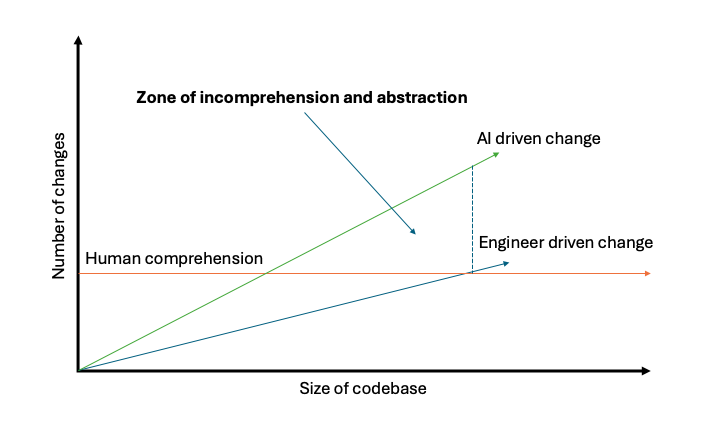
_Graph: Code changes versus codebase size, plotting the AI-driven rate of change against the engineer-driven rate of change. A horizontal threshold line marks the limit of human comprehension. The AI-driven rate crosses this line significantly sooner than the engineer-driven rate, creating the Zone of Incomprehension and Abstraction — the region where the rate of AI-driven change exceeds a human's ability to fully comprehend the system._
The graph makes the problem concrete. The engineer-driven rate of change is gradual enough that comprehension more or less keeps pace. The AI-driven rate of change is so steep that it crosses the comprehension threshold early, and from that point forward the engineer is operating in the Zone of Incomprehension and Abstraction. In this zone, the engineer may not fully understand what the codebase does, what has changed, or what may break next.
Key Terms
Comprehension Gap — The growing difference between the rate at which AI can change a codebase and the rate at which a human engineer can fully understand those changes.
Zone of Incomprehension and Abstraction — The region beyond the human comprehension threshold, where AI-driven change is accumulating faster than any engineer or team can meaningfully track or understand.
AI-Enabled Process — A team-level workflow in which AI is not merely assisting individual contributors but is operating as a structured participant in the engineering process, governed by standardized instructions and validated by automated quality controls.
Recognizing the Comprehension Threshold
- Declining test coverage percentage despite increasing code volume - AI is adding code faster than tests are being written to validate it
- Increasing code churn rate — the same files being changed repeatedly in short cycles - Changes are being made without sufficient understanding of their downstream effects
- Slower code review turnaround or reviews becoming more superficial - Reviewers can no longer meaningfully evaluate AI-driven changes at the volume being produced
- Rising bug rate in recently AI-modified modules - AI-driven changes are introducing regressions that comprehension-based review is missing
- Engineers unable to explain the behavior of recently changed modules - The most direct indicator, if your team cannot describe what the code does, you are in the zone
- Increased reliance on "it passes the tests" as the sole quality criterion - A symptom of comprehension loss disguised as process compliance
If you are observing three or more of these signals simultaneously, your team is likely operating in the Zone of Incomprehension and Abstraction and needs deliberate intervention. The strategies described in the remainder of this article are designed to address exactly this situation.
To utilize AI to its maximum potential, we must devise methods and procedures to manage this zone — to keep the engineer informed and in control even as AI drives change at a rate no human could match alone. This is the difference between simply amplifying individual contributors and building genuinely AI-enabled engineering processes.
From the perspective of a software engineer, there is a clear and important relationship between AI and testing that speaks directly to this problem. AI accelerates the rate of change while testing helps control the quality of that change. Automated testing therefore becomes a key instrument for heuristically managing the comprehension gap — providing signals that keep the engineer anchored to the reality of the codebase even as it changes at AI speed. Critically, this testing must be automated so that both AI and the engineer can use it as a reliable feedback mechanism.
Testing
To understand how testing helps manage the Zone of Incomprehension and Abstraction, it is worth reviewing how automated testing has traditionally functioned in software projects. The testing pyramid provides a useful framework.
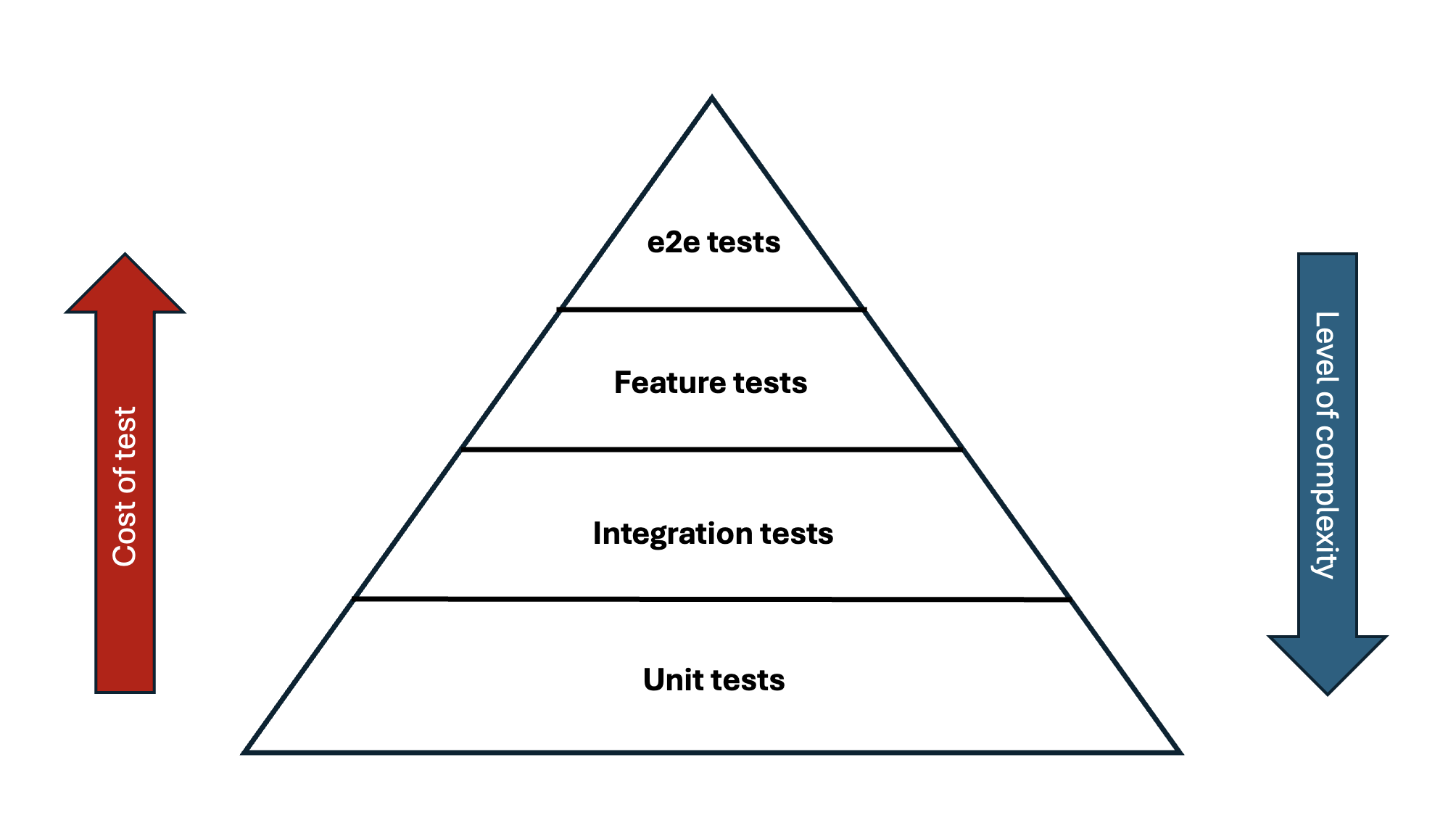
The testing pyramid, illustrating the relative cost and volume of different test types. Unit tests form the broad, low-cost base. Integration tests occupy the middle tier. End-to-end tests sit at the narrow, high-cost apex.
The base of the pyramid is unit tests. They are cheap to create, fast to run, and effective at detecting bugs early in the development process. They are also highly effective at regression prevention — if AI-driven changes break existing behavior, a unit test will catch it immediately, giving the engineer a concrete signal that something has changed in a way that matters.
Beyond bug detection, unit tests serve a documentation function. A well-written test suite describes what the code is supposed to do, module by module, function by function. In the context of the comprehension gap, this is significant. When an engineer can no longer hold the entire AI-modified codebase in their head, the test suite becomes a map — a structured, executable description of the system's intended behavior. This is why a strong testing strategy becomes the keystone to maintaining control as AI accelerates change. We will focus on unit tests throughout this article, as they are the most practical to automate and deliver the highest return at the base of the pyramid.
However, the traditional model of testing has real limitations in practice. Adoption has had mixed results across many companies despite well-known advantages. The most common complaint from software engineers has been the lack of time to write tests. Another frequent source of failure has been partial implementation within a team. Testing requires all team members to invest in it consistently; otherwise, individual engineers are forced to cover the test debt of the entire team. This eventually affects morale and leads to the abandonment of testing altogether — leaving the codebase without its map precisely when it is needed most.
AI and Testing
With AI available for test generation, the traditional limitations of testing largely disappear — and this changes the economics of managing the comprehension gap entirely.
Time for test implementation is no longer an issue. AI can write more than 50 unit tests in 30 seconds. That is not an exaggeration — it is a routine outcome. To put this in sprint terms: a testing backlog that might have represented two to three days of engineer time can now be addressed in a single working session, with the engineer's time spent on validation rather than writing. Even accounting for the time needed to analyze and validate those tests, the time barrier that has historically prevented consistent test adoption is effectively removed.
It is worth being direct about one important risk here. AI can generate tests that pass but test the wrong thing. If AI writes both the code and the tests without sufficient human oversight, there is a real danger that the tests simply confirm what the AI did, rather than verifying what the system should do. A passing test suite built on this basis provides false confidence and actually deepens the comprehension gap rather than addressing it. This is why the shift from implementation to analysis is so critical.
As a software engineer using AI for testing, your role changes. You are no longer primarily a writer of tests — you are an analyst and validator of them. You must examine AI-generated tests to confirm they are meaningful, that they test the right behavior, that edge cases are genuinely covered, and that the test suite as a whole accurately maps the system's intended state. This analytical role is how you stay anchored within the Zone of Incomprehension and Abstraction — the tests are your instrument panel, but only if you have verified they are reading correctly.
The partial adoption problem is also addressed. When any team member can generate a comprehensive test suite in seconds, the imbalance that previously demoralized testing advocates is removed. The investment required of each team member shifts from hours of writing to minutes of review.
AI Instructions and Prompts
Removing the time barrier for testing is valuable, but it introduces a new challenge: consistency. Manually prompting AI with the same request five times will most likely produce five different results. If each team member prompts AI for tests in their own way, the resulting test suites will vary in structure, coverage approach, naming conventions, and depth. This inconsistency undermines the standardization that makes a test suite useful as a team-wide instrument for managing the comprehension gap.
The solution is AI instruction and prompt files. Most AI platforms offer the ability to define and control AI behavior through structured markdown files [3][4][5]. These files allow you to specify precisely how AI should generate tests — what conventions to follow, what coverage to target, what edge cases to consider, and how tests should be structured and named.
Generic Unit Test Prompt File
The following example is framework-agnostic and intended to illustrate the structure.
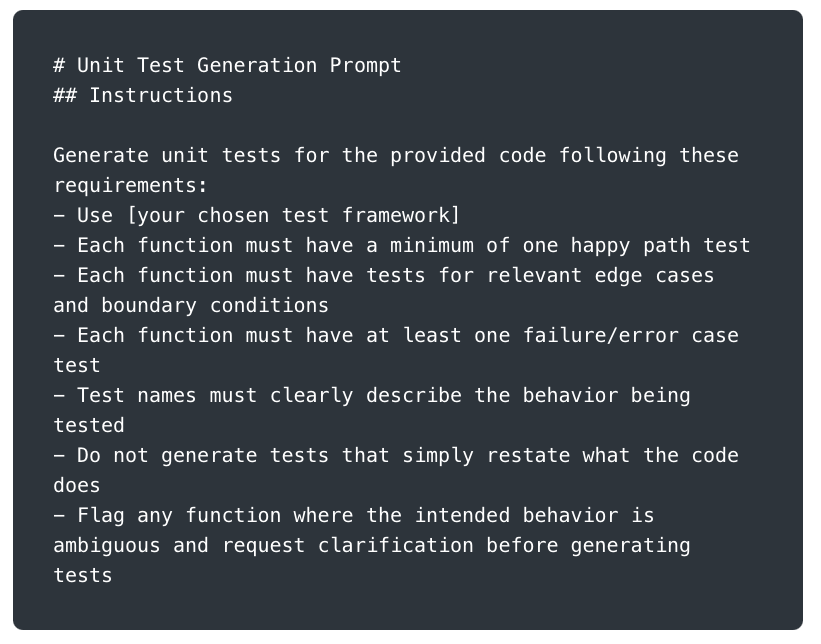
These standardized prompt files transform AI-assisted testing from an individual habit into a team-level process. Every engineer on the team uses the same instruction set, producing consistent, comparable test suites regardless of who generates them. This is a meaningful shift — from AI as a tool that amplifies individual contributors to AI as the foundation of a shared, repeatable engineering process.
It is also worth noting that once these instruction and prompt files exist, you can instruct AI to run tests as part of its own code-writing workflow. AI can be directed to generate tests first, use them to validate its own code output, and flag failures before the engineer reviews anything. At this point, the test suite is not just a map for the human — it is also a control mechanism for the AI itself.
CI/CD Integration
Continuous Integration and Continuous Delivery (CI/CD) [6] is the practice of automatically building, testing, and deploying code whenever changes are made to the codebase. In practical terms, this means that every time a change is pushed — whether by an engineer or AI — the full test suite runs automatically, and the team is alerted immediately if anything breaks.
Incorporating AI-generated unit tests into your CI/CD pipeline is the final step in making testing a reliable instrument for managing the comprehension gap at scale. Without CI/CD integration, tests exist but require manual effort to run consistently. With CI/CD integration, every AI-driven change is automatically validated against the test suite the moment it is committed. The engineer does not need to remember to run the tests — the pipeline enforces it.
For engineering managers and non-technical stakeholders, CI/CD can be thought of as a quality gate. No change — regardless of how quickly AI produced it — passes into the product without being checked against the documented, validated description of how the system should behave. In the context of the Zone of Incomprehension and Abstraction, CI/CD means that even when an engineer cannot fully comprehend every change AI has made, the pipeline can still catch regressions automatically and alert the team before they reach production.
Conclusion
The human comprehension gap is the central challenge of AI-enabled software engineering. AI can change a codebase faster than any human can fully understand, and without deliberate strategies to manage this, engineering teams will find themselves operating in the Zone of Incomprehension and Abstraction — making decisions about a system they no longer fully comprehend.
Unit testing, AI-generated and human-validated, is one of the most practical and immediately available tools for managing this zone. It provides the signal — through passing and failing tests — that keeps engineers informed about the real state of the system even as AI drives change at a pace no human could match unaided. AI dramatically reduces the cost of producing this safety net, removing the time and adoption barriers that have historically limited testing in practice.
However, it is important to be clear: testing is one layer of control, not a complete solution. The approach described here is deterministic — tests catch what they are written to catch. They do not catch what was never anticipated. As AI-driven processes become more sophisticated, additional strategies will be needed: more advanced validation techniques, AI-assisted code review, architectural guardrails, and eventually process designs where AI operates within formally defined constraints. These represent the next tier of AI-enabled engineering strategy and will be explored in a subsequent article.
What matters most right now, as a software engineer or engineering leader, is developing your ability to recognize the comprehension gap, understand where your team sits relative to the Zone of Incomprehension and Abstraction, and build deliberate processes — starting with testing — to keep AI-driven change under informed human control.
Recommendations
Immediate Actions
- Use AI to design your testing strategy — ask AI to propose a unit testing approach appropriate for your codebase and tech stack
- Use AI to write your unit tests — generate tests for existing code to establish a baseline before accelerating with AI-driven changes
- Validate, do not just accept — analyze every AI-generated test to confirm it tests the right behavior, not just the behavior AI happened to produce
- Monitor your comprehension threshold signals — track test coverage, code churn, review turnaround, and bug rates in AI-modified modules as early warning indicators
Process and Standardization
- Create an AI instruction file to define your testing standards, conventions, and coverage requirements [3][4][5]
- Create language-specific AI prompt files to standardize how AI generates tests across your team and tech stack
- Incorporate tests into your CI/CD pipeline [6] so that every change — AI-driven or human-driven — is automatically validated
Advanced AI-Driven Process
- Instruct AI to use tests as part of its own workflow — direct AI to generate tests before writing code and to validate its output against them
- Develop a broader AI-driven testing strategy that defines how AI participates in quality control across the full development cycle
- Actively assess your position relative to the comprehension threshold — as AI usage increases, ensure your test coverage is keeping pace with the rate of AI-driven change
References
- Agile methodology - https://agilemanifesto.org
- Key Performance Indicator (KPI) - https://www.atlassian.com/agile/project-management/metrics
- GitHub Copilot prompt files - https://docs.github.com/en/copilot/customizing-copilot/adding-repository-custom-instructions-for-github-copilot
- GitHub Copilot instruction files - https://docs.github.com/en/copilot/customizing-copilot/adding-repository-custom-instructions-for-github-copilot
- Claude instruction files - https://docs.anthropic.com/en/docs/build-with-claude/prompt-engineering/system-prompts
- GitHub Actions — CI/CD Documentation - https://docs.github.com/en/actions/about-github-actions/understanding-github-actions