From Amplification to Automation: A Practical Framework for AI-Driven Software Engineering
Date: 2026-06-04 7:44pm CT
Introduction
The rapid advancement of AI presents software engineering teams with both an extraordinary opportunity and a significant organizational challenge. While AI can generate, analyze, and transform code at speeds orders of magnitude faster than any human, most teams are only scratching the surface of what is possible. Using AI to amplify individual contributors rather than to fundamentally transform their processes and workflows.
This essay proposes a staged framework for teams to progressively adopt AI-driven workflows, bridging the gap between individual AI use and full process automation. Each stage represents a meaningful shift in how a team thinks about, shares, and leverages AI. Moving from isolated personal use toward a collaborative, documentation-driven, and eventually automated AI-enabled engineering culture.
The central challenge this framework addresses is the human incomprehension gap: the point at which the rate of AI-driven change exceeds a human's ability to fully comprehend, validate, and govern that change. Crossing this gap is not a matter of individual skill or determination, it is a structural problem that requires a structural solution. Without a deliberate strategy to transition from individual AI amplification to AI-driven processes, most teams will plateau well below their potential.
Observations
To leverage AI speed effectively, it is worth examining the implications of more AI-centric workflows in detail. The following observations come from direct experience as a software engineer committed to integrating AI into the software development lifecycle. Each point contributes to the level of abstraction that a software engineer must be comfortable operating at when working with AI:
- Analysis and critical thinking are your primary activities, not implementation
- AI produces significantly more data as part of the process
- Documentation becomes a first-class citizen
- Automated testing is no longer optional — it is a requirement
- Understanding and building context is a primary skill requirement
- Combining AI and automation enables standardization, repeatability, and scalability
- If you are writing code yourself, you are not fully using AI
- If your team is not using and sharing their AI instructions, prompts, and documentation, then the team is using AI as a group of individual contributors rather than as a cohesive, compounding unit
- The ability to understand and work with abstraction is a crucial and increasingly central skill
These observations are not independent of one another. Together, they describe a fundamental shift in the software engineer's role: from implementer to architect of AI-driven processes. This shift is the underlying theme of every stage that follows.
AI Utilization
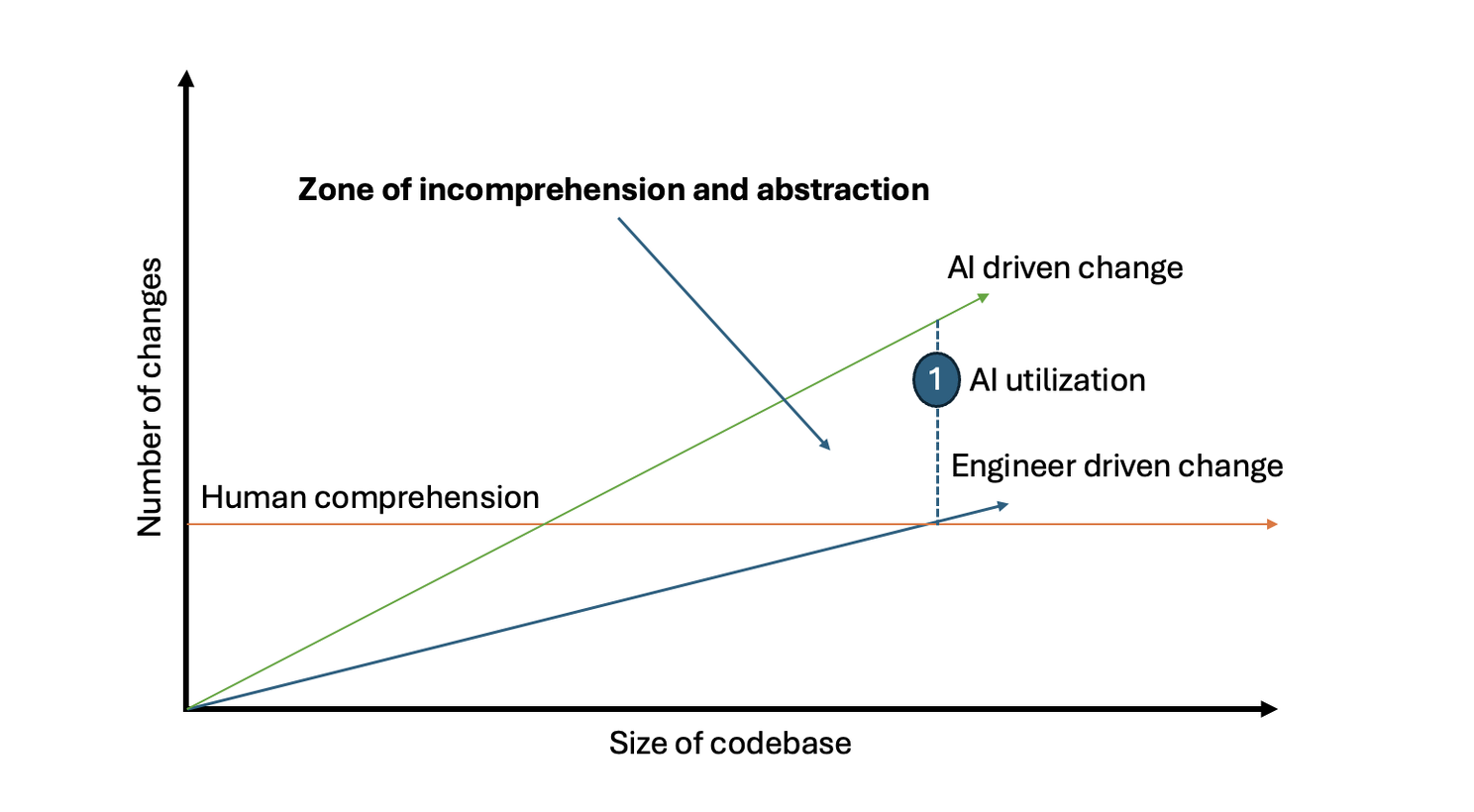 _Code changes versus codebase size, plotting the AI-driven rate of change against the engineer-driven rate of change. A horizontal threshold line marks the limit of human comprehension._
Before addressing an approach to bridging the human incomprehension gap, it is worth revisiting the graph from article [1]. The graph has been redrawn to focus on the vertical axis, the spectrum between purely individual, non-AI-assisted work at the bottom and fully AI-driven processes and workflows at the top. This essay is a discussion of climbing this vertical to reach the highest level of AI utilization possible.
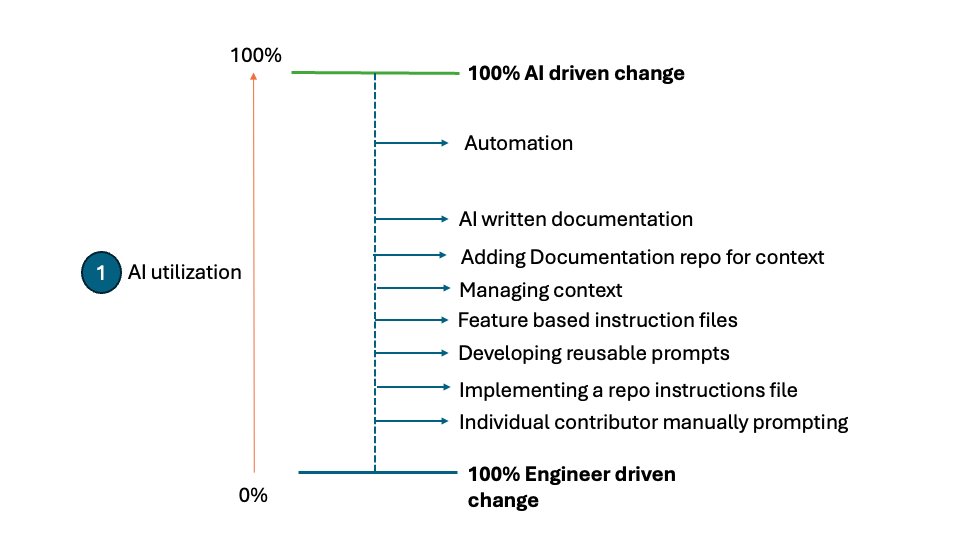 _The AI utilization vertical_
The stages described in this essay represent one path up this vertical, shaped by direct experience and offered as a practical starting point rather than a definitive prescription. The upper portion of the vertical is represented by the general term automation, as achieving 100% AI-driven workflows is not a trivial task and remains an active area of research and development across the AI industry.
Ground Zero
The starting point of the vertical represents traditional software engineering workflows with no AI involvement. There is no advantage from AI at this level, as it is not being used. This is ground zero and typically provides the baseline against which AI-enabled workflows are compared and their success measured.
The signal that a team is ready to leave ground zero is straightforward: one or more engineers have begun experimenting with AI tools independently and are seeing productivity gains that the broader team is not yet sharing. That asymmetry is the catalyst for the first stage.
Individual Contribution — The First Stage
This stage is defined by individual contributors leveraging AI for their own workloads and is characterized by the amplification of individual productivity. This approach is a natural and sensible entry point when introducing AI into an organization for the first time. Teams need to build AI expertise alongside a solid working knowledge of the company's systems and workflows in order to construct useful and accurate context for AI interactions. The primary skill developed at this stage is prompt engineering, the ability to communicate intent to an AI system clearly and effectively, and a foundational capability for everything that follows.
While this stage delivers real and measurable productivity gains, it has a clear ceiling. Knowledge remains siloed with individuals, prompts are not shared or standardized, and the team as a whole does not benefit from what each engineer is discovering. The productivity gap between AI-enabled and non-AI-enabled team members begins to widen in ways that create friction rather than collective progress.
Transition signal: The team is ready to move to the second stage when individual engineers have developed reliable, repeatable prompts for common tasks and are beginning to recognize that colleagues would benefit from access to those same prompts. The bottleneck has shifted from learning how to use AI to distributing that knowledge effectively.
Project-Based AI Prompts and Instructions — The Second Stage
As individual contributors continue developing their AI skills, they will naturally begin formalizing AI-enabled tasks from their daily workflows. A practical example is a standardized prompt for generating pull request descriptions, a repeatable task that benefits directly from a well-defined template. This mirrors the same discipline applied when building DevOps automation: identifying repetitive processes and encoding them in a reliable, reusable form.
This characterizes the second stage: isolated AI-enabled tasks that are adopted as part of the broader team's workflows. The development team is now sharing AI resources. This is a significant and meaningful milestone.
It is imperative that team members design and build AI prompts and instructions that produce standardized, reliable results. Consider the task of writing unit tests: at the individual contribution stage, test generation is typically handled ad hoc, and the developer may approach it differently each time. At this stage, the preferred approach is to use an instructions file [2] and a prompt file [3] containing all the information required to produce standardized unit tests, including test naming conventions, coverage requirements, and expectations for models, types, and features.
There should be sufficient information documented that a software engineer could read it and produce conforming tests without additional guidance. This is a key observation worth generalizing: when writing prompts and instructions, you should be able to hand them to another software engineer who can, without assistance, manually execute the prompt's workload. If the engineer has questions, update the prompt or instructions with the answers. A prompt that cannot be manually executed is a prompt that is not yet well enough defined.
Transition signal: The team is ready to move to the third stage when the shared prompt library is stable and in regular use, but engineers are spending increasing effort re-explaining feature-specific context within individual prompts. The repetition of that context signals that it needs a permanent home, one that exists independently of any single prompt or conversation.
Feature Based Instructions - The Third Stage
The goal at this stage is to provide detailed, structured information regarding the features being built for the project, so that AI has the context it needs to contribute meaningfully without requiring repeated explanation. Using Copilot as an example, a Markdown file named _<feature>.instructions.md_ is created and placed in _<project root>/.github/instructions/_. When working on the feature, AI will have all the relevant context available automatically. Most AI-enabled editors provide equivalent functionality, the implementation details may differ, but the objective is consistent: persistent, structured feature context that the entire team can read, contribute to, and rely upon.
This stage eliminates dependence on any individual engineer's memory of a feature's requirements, constraints, and design decisions. The team as a whole benefits from a shared, living definition of what is being built and why. Feature instructions files also serve as lightweight specification documents, providing value beyond their role as AI context.
Transition signal: The team is ready to move to the fourth stage when feature instructions files are in regular use but engineers are noticing that AI responses vary in quality depending on what context is included in a given session. The inconsistency is not a prompt quality problem, it is a context management problem. The team has accumulated enough shared knowledge that managing what gets passed to AI, and when, has become a discipline in its own right.
Managing Context - THe Fourth Stage
Context drives the accuracy and usefulness of AI prompts and can deliver significantly better results when managed deliberately. Context is not simply conversation history, it encompasses previous decisions, user data, feature details, knowledge bases, situational awareness, and background information that is passed alongside every prompt to the AI. Most AI APIs enforce a hard limit on context size, making deliberate context management not just beneficial but necessary.
Effective context management requires engineers to think carefully about what information is most relevant to the task at hand and how to surface it efficiently. This discipline, knowing what to include, what to exclude, and how to structure the information that is passed to AI is a skill that develops progressively and has a direct and measurable impact on the quality of AI output.
This process also forces a broader and more critical evaluation of the project's existing documentation. Context management exposes gaps, inconsistencies, and outdated information that degrade AI performance. Addressing those issues to improve AI output has the secondary effect of improving the team's shared understanding of the system, a compounding benefit that becomes more valuable over time.
Transition signal: The team is ready to move to the fifth stage when context management has revealed that the project's documentation is insufficient, inconsistent, or scattered across too many locations to be used reliably as AI context. The solution is not better context management, it is better documentation. That recognition marks the entry point into the next stage.
Documentation and Context Building — The Fifth Stage
At this stage, the team is sharing AI resources prompts, instructions, and context as a routine part of the development workflow. Engineers have developed a working understanding of how prompts and instructions behave and are actively identifying opportunities to improve them. A common and important observation at this stage is that many prompts contain duplicated information: repeated coding standards, feature descriptions, or architectural decisions that appear across multiple prompts independently. This stage is characterized by extracting that shared information from individual prompts and consolidating it into reusable documents that can be passed in as context when needed.
It becomes evident that prompts perform measurably better when provided with well-structured, relevant documentation. Markdown is a practical and effective format for this purpose, it provides rich context to AI prompts while remaining clearly readable and maintainable by human engineers.
This recognition of documentation's role in AI-driven workflows leads naturally to the creation of a dedicated documentation repository to host the project's shared knowledge. Documentation creation and maintenance then becomes a formal part of the engineering process rather than an afterthought. This approach is structurally similar to Retrieval-Augmented Generation (RAG) [4], documentation is added as context to prompts, and prompts in turn update the documentation based on completed work. AI is now actively contributing to the team's knowledge base as a natural byproduct of its work.
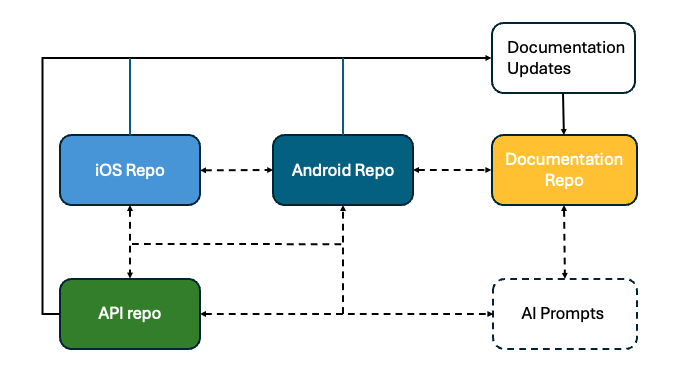 _Enabling prompts with the documentation repo _
The documentation repository is structured to provide a hierarchical view of relevant project information, allowing engineers to provide focused, detailed context to prompts at the appropriate level of granularity. For example, adding a specific feature's directory to the prompt context while working on that feature. Keeping this repository in sync with the project's code repositories is essential, and AI can assist significantly with this task. AI-generated documentation is consistently detailed and well-structured, in many cases superior in quality and completeness to what is typically produced manually.
Transition signal: The team is ready to move to the sixth stage when maintaining the documentation repository has become a meaningful workload in its own right. One that is increasingly difficult to sustain through manual effort as the codebase grows. The documentation is valuable and in active use, but the cost of keeping it current is becoming a bottleneck. The solution is to delegate that maintenance task to AI itself.
AI-Written Documentation — The Sixth Stage
Managing a documentation repository becomes a significant and ongoing task as the project's codebase grows. Using AI as a discovery tool on a pre-existing codebase and directing it to explore the code and produce structured Markdown documentation from that discovery work quickly demonstrates both the quality and the scalability of AI-generated documentation. The level of detail, accuracy, and consistency that AI brings to documentation tasks frequently exceeds what most engineers produce under normal delivery pressures.
This leads to a clear and practical conclusion: at scale, the only sustainable approach to maintaining a documentation repository is to assign the task formally to AI and treat documentation generation as a defined requirement of every user story. Changes to the codebase are accompanied by corresponding changes to the documentation, not as an optional step, but as a completion criterion.
To address drift between the codebase repositories and the documentation repository over time, a documentation audit prompt can be defined and executed periodically, with its output reviewed by a team member before any updates are merged. This keeps the documentation repository accurate and trustworthy without requiring disproportionate manual effort.
Transition signal: The team is ready to move to the final stage when AI-written documentation is stable, the documentation repository is reliably current, and engineers are beginning to recognize that many of the tasks they invoke AI for manually such as documentation updates, test generation, standards checking could be triggered automatically at defined points in the workflow. The manual invocation of repeatable AI tasks is itself the inefficiency that automation is designed to eliminate.
Automation — The Final Stage
Automation represents the upper tier of the AI utilization framework and, for most teams, the frontier of what is currently achievable. At this level, the team's workflows and processes are predominantly AI-driven, with human engineers focused primarily on oversight, decision-making, and the definition of intent rather than the execution of tasks. The specific implementation of automation will vary across teams and organizations, but the underlying principle is consistent: AI is embedded directly into the engineering process, not invoked manually on the side of it.
Defining the Automation Boundary
The foundational challenge at this stage is not technical, it is analytical. The team must identify precisely where human judgment adds the most value and design automation around those boundaries. Not every step in a workflow benefits equally from automation, and automating the wrong steps can introduce risk without meaningful gain. A disciplined approach to this analysis is what separates effective automation from automation for its own sake.
Human oversight is most valuable at decision points: architectural choices, security-sensitive changes, external-facing API contracts, and any change with significant downstream dependencies. Automation is most valuable at execution points: test generation, documentation updates, code formatting, dependency checks, and routine validation tasks that follow well-defined rules. The engineering team's role at this stage is to maintain a clear and continuously updated map of which activities fall into which category.
AI in Continuous Integration and Delivery
One of the most practical entry points for automation is the integration of AI-driven prompts into CI/CD pipelines via tools such as GitHub Actions. Rather than requiring an engineer to manually invoke an AI prompt to generate tests, update documentation, or validate code standards, these tasks can be triggered automatically as part of the pipeline — executed at the point of a pull request, a merge, or a scheduled workflow run.
Concrete examples of AI-driven CI/CD automation include:
- Automated documentation validation: On every pull request, an AI-driven workflow compares the changes to the codebase against the current documentation repository and flags discrepancies for review
- Test coverage analysis and gap identification: AI reviews new code additions and identifies untested paths, generating candidate unit tests for engineer review and approval
- Pull request summarization: AI generates a structured description of every pull request, including a plain-language summary of changes, affected components, and potential risk areas
- Standards compliance checking: AI evaluates submitted code against the project's documented coding standards and architectural guidelines, surfacing violations before human review begins
- Release note generation: AI compiles structured release notes from merged pull requests, commit messages, and linked issues, ready for editorial review
Each of these examples shares a common structure: AI executes a well-defined, repeatable task; a human reviews and approves the output; and the result is integrated into the team's standard workflow without manual invocation.
Agentic Workflows
Beyond discrete automation tasks, the frontier of this stage involves agentic AI workflows — systems in which AI operates across multiple steps, tools, and decisions with a defined goal and minimal human intervention at each step. An agentic workflow might, for example, receive a user story, query the documentation repository for relevant context, generate an implementation plan, produce the corresponding code and tests, update the documentation, and submit a pull request — all as a coordinated sequence of actions rather than a series of individually prompted responses.
Agentic workflows introduce a higher degree of complexity and a corresponding need for robust validation and rollback mechanisms. The team must define clear boundaries for what an agent is permitted to do autonomously and what requires human approval before proceeding. Governance frameworks for agentic AI — including audit trails, approval gates, and escalation paths — become a necessary part of the engineering infrastructure at this stage.
Measuring and Governing Automation
As automation matures, measurement becomes essential. Teams operating at this level should define and track metrics that reflect the health and effectiveness of their AI-driven workflows:
- Automation coverage: The proportion of standard engineering tasks that are executed by AI without manual invocation
- Human intervention rate: The frequency with which automated AI tasks require human correction or override, indicating areas where prompts or instructions need refinement
- Cycle time reduction: The measurable decrease in time from task initiation to completion attributable to AI-driven automation
- Documentation drift rate: The frequency and magnitude of discrepancies between the codebase and the documentation repository, as identified by audit prompts
These metrics serve a dual purpose: they demonstrate the value of AI investment to organizational stakeholders, and they provide the engineering team with a continuous feedback loop for improving the quality and reliability of their automation.
Risks and Limitations
No framework for AI adoption is complete without an honest account of the risks involved and the conditions under which the approach may not apply. The following risks are not hypothetical — they are patterns that emerge consistently as teams attempt to scale AI utilization and should be treated as active considerations throughout the journey.
Over-Reliance on AI Output
As AI becomes more deeply embedded in the engineering process, the risk of uncritical acceptance of AI-generated output increases. Engineers who interact primarily with AI at a high level of abstraction may lose familiarity with the underlying implementation details — reducing their ability to identify errors, evaluate trade-offs, or recover from failures. This is the most fundamental tension in the framework: the productivity gains of abstraction come at the cost of direct comprehension.
Mitigation requires deliberate investment in maintaining engineering depth alongside AI breadth. Code reviews, architectural discussions, and periodic manual implementation exercises are not inefficiencies to be automated away — they are mechanisms for preserving the human judgment that AI governance depends on.
Prompt and Instruction Decay
Prompts and instructions that are not actively maintained will degrade in quality over time as the codebase, the team's standards, and the project's requirements evolve. A prompt that produced reliable results at the time it was written may produce incorrect, outdated, or misleading output months later if it has not been updated to reflect changes in the system it describes.
Teams must treat prompts and instructions as living artifacts — subject to the same version control, review, and maintenance discipline as code. Establishing a regular cadence for prompt auditing, particularly for prompts embedded in automated workflows, is a practical and necessary safeguard.
Context Poisoning
Because AI output is heavily influenced by the context it receives, inaccurate, incomplete, or outdated documentation passed as context can systematically degrade the quality of AI responses across the team. If the documentation repository drifts from the actual state of the codebase, whether due to incomplete updates, ambiguous language, or conflicting information. The AI will produce output that is confidently wrong in ways that are difficult to detect without deep system knowledge.
The documentation audit process described in the sixth stage is a direct response to this risk, but it is not sufficient on its own. Documentation quality must be treated as a first-order engineering concern, with clear ownership, defined standards, and regular validation.
Uneven Adoption and Team Fragmentation
When individual team members adopt AI at significantly different rates, the resulting productivity asymmetry can create friction rather than collective progress. Engineers who have developed sophisticated AI workflows may find it difficult to collaborate effectively with colleagues who are still working manually, and the benefits of shared prompts and documentation may be undermined if a significant proportion of the team does not engage with them.
Managing adoption pace as a team-level concern rather than leaving it entirely to individual initiative is essential. This includes establishing shared norms for AI usage, providing structured onboarding for team members at earlier stages of the framework, and ensuring that the benefits of AI adoption are visible and accessible to the whole team.
Organizational and Policy Constraints
AI adoption does not occur in isolation. Data privacy policies, security requirements, regulatory constraints, and organizational risk appetite can all impose meaningful limits on what is permissible within a given environment. Teams that design AI workflows without accounting for these constraints risk building processes that cannot be deployed, scaled, or sustained within their organizational context.
Engaging with security, compliance, and legal stakeholders early in the adoption process and incorporating their requirements into the design of prompts, instructions, and automation is significantly less costly than retrofitting those requirements after the fact.
The Automation Risk Surface
As automation increases, so does the potential impact of a failure. A misconfigured prompt in a manual workflow produces a single incorrect output that is caught and corrected by the engineer who invoked it. The same misconfigured prompt embedded in a CI/CD pipeline may produce incorrect output across every pull request until the error is identified and addressed. The efficiency gains of automation are proportional to the risk surface they introduce.
Robust testing, staged rollout, and human review gates for automated AI tasks are not optional safeguards — they are structural requirements for operating AI at this level responsibly. Every automation that is introduced should be accompanied by a defined failure mode, a detection mechanism, and a rollback procedure.
Conclusion
The framework described in this essay represents a structured path from the earliest, most tentative use of AI by individual contributors to a mature state in which AI is embedded as a core capability within the engineering process itself. Each stage builds deliberately on the last, developing skills, establishing shared resources, formalizing documentation, and progressively reducing the proportion of work that depends on manual execution.
The human incomprehension gap is not a fixed barrier. It is a threshold that shifts as the team's practices, tools, and shared knowledge mature. The goal is not to eliminate human judgment from the engineering process. It is to focus that judgment where it is most valuable: on intent, architecture, oversight, and the continuous refinement of the systems that AI operates within. Equally, the risks outlined in this framework are not reasons to avoid the journey, they are reasons to undertake it with discipline, governance, and a clear-eyed understanding of what is being traded at each stage.
Every team's journey up this vertical will be shaped by its own constraints, culture, and context. There is no single correct path, and the stages described here should be treated as orienting milestones rather than rigid prescriptions. What is consistent across every team that succeeds at this transition is a shared commitment to treating AI not as a personal productivity shortcut but as a collective engineering capability. One that compounds in value as it is developed, documented, and governed as a team.
The organizations that will lead in AI-driven software engineering are not those that adopt AI the fastest. They are those that build the most deliberate, structured, and scalable approach to crossing the human incomprehension gap and that treat the journey itself as a core engineering discipline.
Recommendations
- Create instruction files for your project
- Create and share prompt files across your team
- Use AI to help create and manage documentation
- Use AI to write tests, and incorporate them when writing code
- Incorporate validation steps into prompts
- Have prompts summarize their completed work
- Use AI as a discovery tool on existing codebases
- Build context and documentation for specialized tasks and features
Process and Standardization
- Incorporate project standards into your instructions file(s)
- Break down instructions files into multiple focused files, allowing for detailed and modular definitions
- Use scripts with your prompts to produce standardized, repeatable results
- Develop scripts that can be used to validate AI-written code
- Create documentation repositories for use with prompts
- Document your AI workflows as they mature
- Build a library of prompts for individual teams to adapt to their own workflows
- Develop methods to measure AI adoption and usage across the team
- Develop routines to address the high level of abstraction that comes with AI-driven workflows
Automation and Governance
- Identify and map the boundary between tasks suited to automation and those requiring human judgment
- Integrate AI-driven prompts into CI/CD pipelines for repeatable, high-frequency tasks
- Define governance frameworks for agentic AI workflows, including approval gates and audit trails
- Establish automation metrics and review them on a regular cadence
- Treat documentation currency as a pipeline requirement, not an optional maintenance task
Risk Management
- Establish a regular prompt and instructions audit cadence
- Define failure modes, detection mechanisms, and rollback procedures for every automated AI task
- Engage security, compliance, and legal stakeholders before deploying AI in regulated or sensitive workflows
- Monitor human intervention rates as an indicator of prompt and instruction quality
- Invest in maintaining engineering depth alongside AI-driven abstraction
References
- AI & The Human Comprehension Gap - https://www.linkedin.com/pulse/ai-human-comprehension-gap-peter-hornsby-2dtzc/
- Retrieval-Augmented Generation (RAG) - https://www.google.com/search?q=Retrieval-Augmented+Generation+%28rag%29
- Instruction files - https://docs.github.com/en/copilot/how-tos/copilot-on-github/customize-copilot/add-custom-instructions/add-repository-instructions
- Prompt files - https://docs.github.com/en/copilot/tutorials/customization-library/prompt-files