The foundations of AI driven software Development
Date: 2026-10-01 2:11pm CT
Introduction
AI-driven software development is not simply a faster way to write code. It represents a fundamental shift in how engineering teams work, what skills matter most, and where the risks in a development process actually live. The velocity AI brings is real and significant, but velocity without control produces poor outcomes at speed. The foundations covered in this article exist to provide that control.
The aim here is to codify the foundational roles that testing, documentation, automation (CI/CD), and context management play in AI-driven software development. These are not abstract principles. Testing, documentation, and automation are disciplines most engineering teams already have some relationship with, but AI changes what is required of each of them. Context management is entirely new. Together, they form the practical foundation on which successful AI-driven development is built, and neglecting any one of them will limit the value you get from AI and increase the risk it introduces.
I want to pass on sound engineering practices that you can employ with your own AI initiatives for the betterment of your projects. But before covering each discipline in turn, it is worth being direct about something that is easy to underestimate: adopting AI-driven development is not purely a technical change. It changes how engineers spend their time, how teams collaborate, and what good engineering work looks like day to day. The technical foundations matter enormously, but so does preparing your team for the shift. Both are covered here.
With that framing in place, let's start with the most immediate and visible benefit of AI: the velocity at which work gets done.
There is no doubt in any software engineer's mind about how fast AI can get work done. A team's velocity jumps significantly when the team adopts AI-driven processes. I encapsulate this with an observation about parsing natural language at compute machine speeds, which is exactly what AI does. Large Language Models can parse the entire novel `War and Peace`[2] by Leo Tolstoy in milliseconds. This is approximately a 1,400-page book that would take a human 42 hours and 52 minutes to read at 250 words per minute. This is exactly what I mean when discussing velocity and AI.
With software projects, we are referring to how quickly AI can change the project's source code, a task that developers spend years learning how to do well. In the general sense, this refers to how quickly AI can take a workload's requirements (inputs) and turn them into finished work (outputs). AI is incredibly fast when compared to traditional software development methodologies.
Handling the velocity of AI-driven changes is a major aspect of working with AI. For all intents and purposes, AI is a black box. The inner workings of it are a mystery, so the very thing that empowers AI is also a major concern with its usage. You must be able to understand and comprehend the changes you introduce to a project. This black-box behavior is why we use testing, documentation, and automation to control AI and make sure that changes are correct and meaningful for our project and/or product.
Context
Context is the main conceptual difference with AI-driven development. Let's define exactly what context is, how you should manage it, and why you want to treat it as a discipline. Context is the collection of instructions, related facts, constraints, requirements, conventions, relationships, and company policies that define a project and/or product[3]. It is represented by your project's documentation ecosystem.
This relationship with documentation is what elevates documentation to a first-class AI citizen. Context is what is passed to your prompts and has a direct bearing on the quality of your prompting results. You use documentation to build that context, and when you organize your documentation well, you essentially get to mix and match documents and directories to build precisely the context you want for a given prompt.
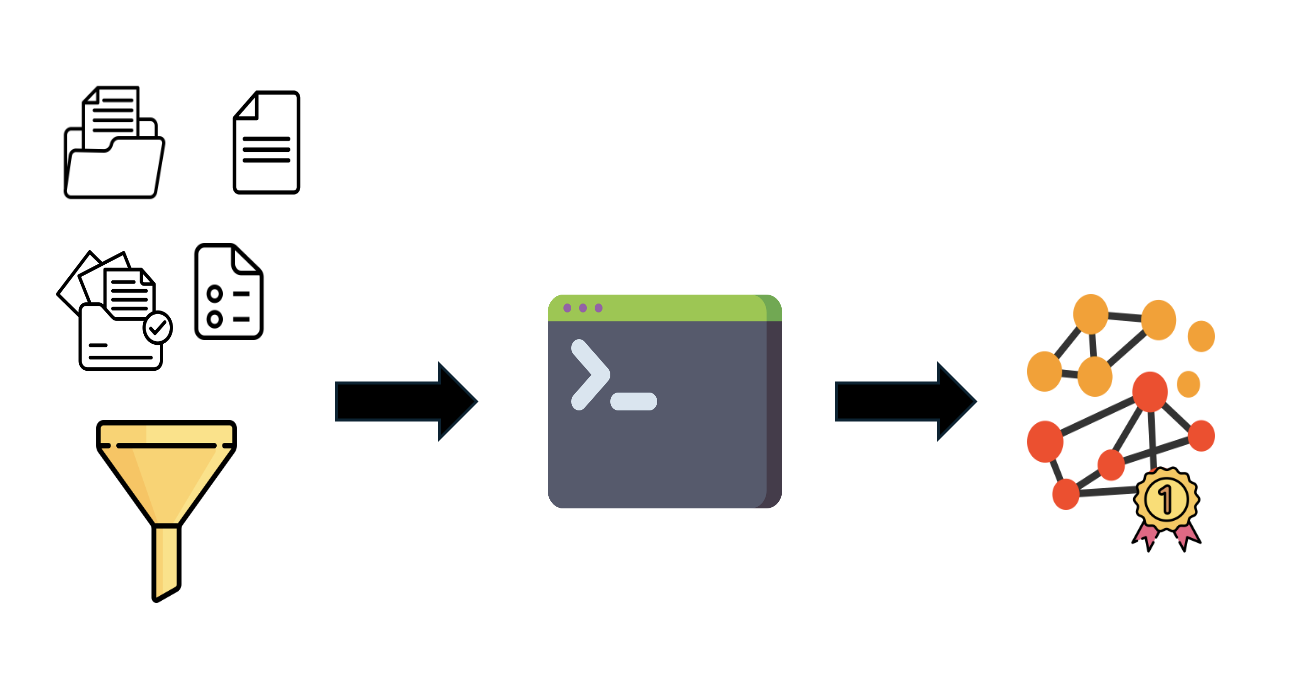 
The aim is simple but not necessarily easy: provide the best context so that your prompt can yield the best possible response. I call these one-hit wonders. A one-hit wonder is a prompt that returns a correct, complete, and usable result on the first attempt, requiring no follow-up or correction. The goal is to get as many of your prompts to achieve that level of success as possible, and good context is the primary driver of that outcome. Traditional software development does not benefit from managing context in this way. It is a discipline wholly new to AI-driven software development.
It is important to recognize that there are types of context. Here are some of the more important ones:
- Structural — how you organize your project's data; a file system hierarchy is a great example of this.
- Architectural — the reasons why certain design choices were made.
- Domain — your product, its users, and their data.
- Constraints — HIPAA in healthcare is a good example.
- Dependencies — what libraries, frameworks, modules, and APIs are used.
What Poor Context Looks Like in Practice
Understanding what good context produces is straightforward once you have experienced it. Understanding what poor context produces is equally important, because the failure modes are common and often misattributed to AI being unreliable rather than to the context being insufficient.
Poor context typically manifests in one of several ways. The most common is an overly generic response. If you prompt AI to add an authentication feature without providing architectural context, domain context, or dependency context, AI will produce a technically valid implementation that may be entirely inconsistent with your existing system. It will choose its own patterns, its own libraries, and its own conventions because you did not supply yours. The result is code that works in isolation but creates friction or conflict within the broader codebase.
A second failure mode is contradiction. When context is incomplete, AI will fill the gaps with assumptions. If those assumptions conflict with undocumented decisions or constraints in your project, the output will need significant rework. This is particularly common with constraint context. An AI that is not told about a regulatory requirement such as HIPAA, or a business rule such as never deleting customer records, will produce output that violates those constraints without any indication that it has done so.
A third failure mode is inconsistency across prompts. Without stable, well-organized context, two prompts addressing related parts of the same system can produce outputs that are technically correct individually but incompatible with each other. This compounds over time and can introduce subtle defects that are difficult to trace back to their origin.
The practical lesson is this: when AI produces a poor result, the first question should not be how do I fix the output, but rather what was missing from the context that caused this result. Treating context as the root cause rather than the output is what moves you toward consistently better prompting outcomes.
Documentation
This is where the most radical change has happened. Documentation is no longer the sole purview of engineers, as it has been up until this point. It now carries the same meaning and value for AI. This represents a game-changing shift in how we think about documentation. Historically, documentation has played a secondary role to the code itself and is typically the first thing to go when deadlines loom over a project. With AI, it is required to be a first-class citizen.
The reason for this elevation is the direct relationship between documentation and context. The context you provide to your prompts has a direct bearing on the quality of your results, and that context is built from your documentation. Well-written, well-organized documentation gives AI the information it needs to produce accurate, relevant, and consistent output. Poorly maintained documentation produces the opposite effect: vague, inconsistent, or incorrect results that require significant correction. This means that investment in documentation is now a direct investment in the quality of your AI-driven development work.
It is also worth noting that the scope of useful documentation has expanded. It is not only technical specifications and API references that matter. Architectural decision records, onboarding guides, domain glossaries, and constraint documentation all become valuable inputs for AI context. The broader and more accurate your documentation ecosystem, the more precisely you can target AI prompts for any given task.
Usage
AI is fast and consistent at writing documentation, which makes it an ideal tool for building out the documentation ecosystem your AI-driven work depends on. You should use AI to write and maintain your documentation, then use that documentation to create the context you need for your individual prompts. Organizing your documentation to align with the types of context relevant to your project will make it significantly easier to build targeted, high-quality context when prompting.
Testing
It all starts with unit tests. They are very effective at detecting bugs, identifying regressions, and are cheap to create (more on this shortly). They are also positioned as far left as possible in the development lifecycle, where bugs are the cheapest to resolve. The most important factor is that you have sufficient test coverage of your application or product for the results to be meaningful. Your coverage really needs to be at or above 85 percent to provide a reliable signal. Below that threshold, gaps in coverage allow defects to pass through undetected, which undermines the entire purpose of automated testing.
The tests must be integrated into your CI/CD solution and function as an automated hard gate. Green means go, red means stop. Failed tests mean you do not progress any further in the CI/CD pipeline, period. This point deserves emphasis: when you allow changes through your testing gates as soft gates rather than hard ones, you are introducing uncertainty into your codebase, diminishing the value of your tests, and eroding the trust your team places in them. A testing gate that can be bypassed is not a gate at all.
This matters even more in AI-driven development because of the velocity at which AI introduces changes. AI can modify large portions of your codebase quickly, and without strong automated testing in place, the risk of undetected regressions grows proportionally with that speed. Testing is the primary mechanism by which you validate that AI-driven changes are correct and that the system continues to behave as expected.
What Happens When AI Tests Verify AI Behavior
There is a specific and important failure mode in AI-driven testing that deserves its own attention. When you ask AI to write tests without clear instructions about what those tests should verify, AI will often write tests that confirm what it just built rather than tests that verify what the system is supposed to do. This is a subtle but critical distinction.
Consider a scenario where AI implements a user registration feature and then writes tests for it. Without clear guidance, AI may write tests that assert the implementation details of its own code: that a specific function was called, that a particular object was instantiated, or that an internal variable holds a certain value. These tests will pass because they are written to match the implementation. They will continue to pass even if the implementation contains a business logic error, because the tests were never written to verify the business logic in the first place.
The correct approach is to define tests in terms of system requirements and expected behavior. A test for user registration should assert that a user with valid credentials can register successfully, that a user with a duplicate email address receives the appropriate error, and that a registered user's data is persisted correctly. These assertions are derived from requirements, not from implementation. They will catch a defect regardless of how the implementation is structured.
This is why your testing instructions for AI must explicitly define what tests should verify. Telling AI to write tests is not enough. You need to tell AI to write tests that verify the expected behavior of the system as defined by its requirements, and to do so independently of the implementation it has just produced.
Usage
To leverage testing effectively in an AI-driven workflow, there are two methods you must adopt. First, use AI to write your tests. This reduces the cost of test creation to almost zero and directly addresses what has historically been the biggest barrier to good test coverage: engineers simply lack the time and resources to write both tests and feature code. AI removes that barrier when implemented correctly.
Second, you must require AI to run the tests as part of its workflow whenever it writes or modifies code. This closes the feedback loop and ensures that AI is validating its own changes before they are presented for review.
To make this work consistently, you need to enable AI to write tests in a standardized and repeatable fashion that verifies what the system should do, rather than simply confirming what AI happened to produce. There are different approaches to this depending on the AI tooling you are using (Copilot, Claude, OpenAI), but they generally involve defining a set of instructions that are applied whenever AI is prompted to change source code. Those instructions should define your testing nomenclature, provide test examples, and outline your test coverage strategy. AI should always use the tests it writes when developing code for your project.
Automation
It is genuinely difficult for humans to repeat exact behavior consistently across thousands of iterations. Every attempt is another opportunity for error, and statistically the likelihood of a mistake increases the more times a task is performed. Each iteration also requires the task's requirements to be assessed again from scratch, before even accounting for the complexity of the task itself. This is where automation comes in. Once set up correctly, automated tasks execute consistently and indefinitely, infrastructure and intentional changes aside.
For software development, the core of automation resides in the CI/CD system. This makes sense, as the CI/CD system is where individual contributions enter the organization's shared codebase and broader systems. Automation does not merely implement an organization's policies; it enforces them. Green means go and red means stop is a simple expression of that enforcement, but it carries significant weight in practice. 
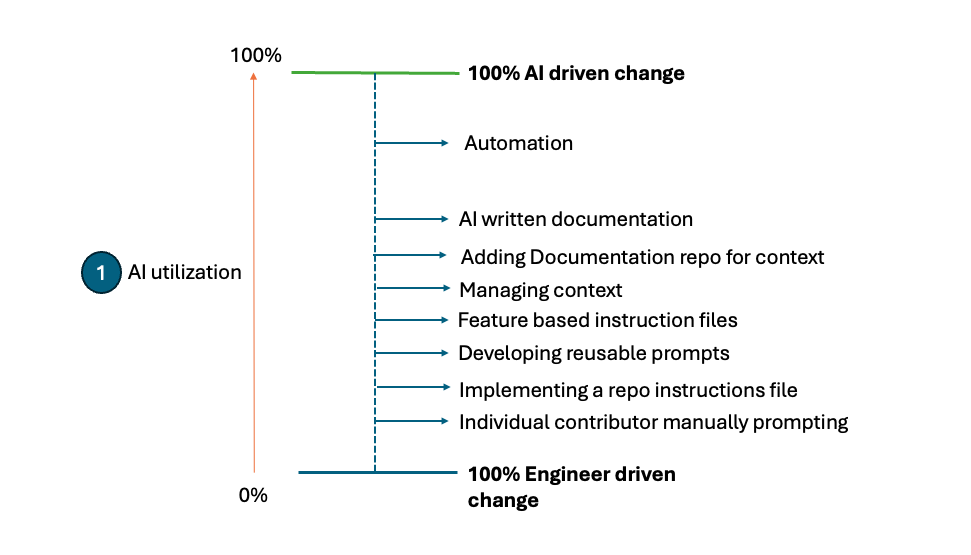
Automation matters for AI because without it you will never fully realize AI's potential in your development process. This is captured in the diagram above, taken from an earlier article[4], which I encourage you to read alongside this one. The diagram illustrates the AI utilization vertical, a framework for thinking about the spectrum from zero AI utilization to 100% AI-driven change. The stages shown represent touch points rather than a fixed sequence, and the goal for engineering teams moving to AI-driven development is to progress as far up that vertical as their automation infrastructure allows. Reaching the higher levels of AI utilization is not possible through manual invocations alone. It requires automation.
Interestingly, the development of AI workflows shares a great deal in common with DevOps and automation work. Both require you to work on a defined piece of functionality until it is complete, initially triggering the work through manual invocations. Once it is working correctly, you integrate it into your existing CI/CD systems. If your organization's automation infrastructure does not support this integration, your development teams will remain stuck with manual invocations of AI workflows, leaving your AI utilization at the lower levels of the AI utilization vertical.
Usage
There are two components to AI automation. The first is the AI workflow itself, and the second is its integration into your existing CI/CD automation. As with DevOps automation, the work is done up front. This requires careful thought, because ill-defined AI workflows can produce a wide variety of technically correct but contextually wrong answers. You need to ensure you have thoroughly mapped the problem space and given AI the information and constraints it needs to account for all likely scenarios.
Integration can radically affect your team's workflows in ways that require preparation. Automating pull request reviews, for example, transforms the review process into something a single engineer can handle independently. These kinds of changes have cultural implications as well as practical ones, and it is worth preparing your team for the shifts that come with AI adoption.
As you automate more AI workflows, you will begin to see bottlenecks and pain points emerge in your CI/CD pipeline. One of the first and most common is an increase in pull requests, as AI accelerates the rate at which code is produced. Planning for this early will save your team significant friction down the line.
Managing the Cultural Shift
The technical foundations covered in this article are necessary but not sufficient. Adopting AI-driven development also requires engineering teams to adapt to a meaningful shift in how work gets done, how it gets reviewed, and what is expected of individual engineers.
The most immediate change is in the nature of engineering work itself. As AI takes on more of the implementation work, engineers spend less time writing code and more time defining requirements clearly, reviewing AI-generated output critically, and maintaining the documentation and context systems that AI depends on. For engineers who have built their identity and confidence around writing code, this shift can feel disorienting at first. It is worth acknowledging this directly with your team rather than assuming the transition will be frictionless.
The review process also changes. AI produces output faster than traditional development, which means the volume of changes requiring review increases. Teams that automate parts of the review process, such as static analysis, test validation, and style enforcement, will handle this volume more effectively than teams that rely entirely on manual review. This is not a reduction in quality standards; it is a reallocation of review effort toward the decisions that genuinely require human judgment.
There is also a trust calibration that teams need to work through. Engineers new to AI-driven workflows often oscillate between over-trusting AI output and dismissing it too readily. Neither extreme serves the team well. The goal is a calibrated skepticism: using the testing and validation processes described in this article to verify AI output systematically, rather than relying on gut feel or accepting output uncritically.
Finally, the team's relationship with documentation changes. Engineers who previously saw documentation as a low-priority task separate from real work will need to understand that in an AI-driven workflow, documentation is part of the development process. Building this understanding early, and reinforcing it through the standards and practices described here, will smooth the transition considerably.
Conclusion
There is a definite sense of coming full circle when acknowledging the foundational impact of testing, documentation, automation, and context management on AI-driven development. The success of your AI initiatives rests on the foundations of good testing, thorough documentation, and a mature CI/CD implementation. The basics matter, and they matter more than ever, because AI handles the implementation of tests, documentation, and source code at a speed that far exceeds even the best software engineers working manually.
Your role as a software engineer has shifted away from implementation toward orchestration, validation, and planning. This shift places the emphasis squarely on problem solving, which has always been the most important skill in engineering. The source code itself is not what stakeholders outside of engineering care about. What they care about is whether the work is done and whether it works correctly. AI handles more and more of the former. Your job is to ensure the latter.
Testing guards the quality and state of your codebase. Documentation gains new relevance as the primary vehicle for providing AI with the context it needs to produce accurate, useful output. Automation and CI/CD enable higher and more consistent levels of AI utilization than manual invocations ever could. Together, these four disciplines form the foundation on which successful AI-driven software development is built.
Recommendations
The items below are sequenced to reflect a practical order of adoption. Testing and documentation form the foundation and should be addressed first, as everything else depends on them. Automation and context building can follow once those foundations are in place, and AI workflow integration comes last as it requires all the preceding elements to be working well.
- Define how AI should write your tests and create a testing standard
- Have AI runs tests as part of it’s workflows
- Build out a full documentation ecosystem
- Define a documentation standard
- Use AI to write documentation
- Practice context building
- Prepare CICD for AI automation
- Build validation routines into your AI workflows
References
- https://peterhornsby.com/articles/index.html
- https://en.wikipedia.org/wiki/War_and_Peace
- https://peterhornsby.com/articles/ai/documentation-as-a-first-class-ai-citizen.html
- https://peterhornsby.com/articles/ai/from-amplification-to-automation-a-practical-framework-for-ai-driven-software-engineering.html
- https://www.flaticon.com/ (used in diagrams)